


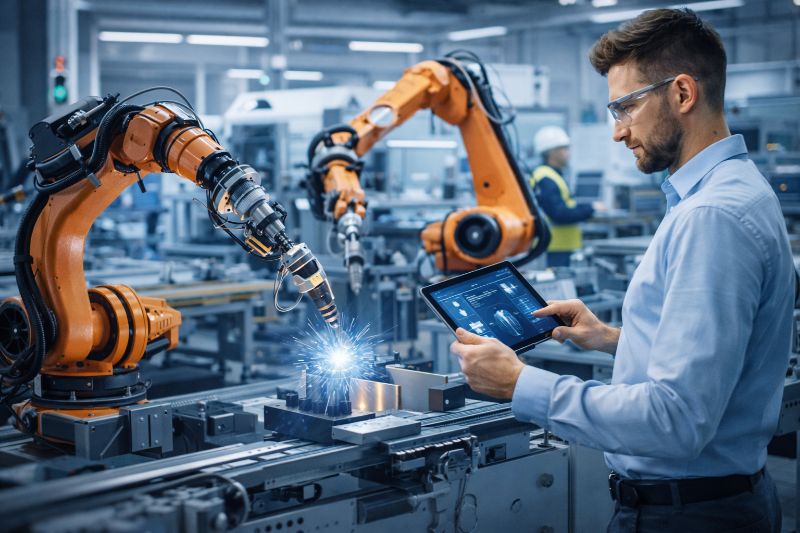
The factory floor was the first site of automation anxiety, and it remains the most visible. Industrial robots now perform welding, assembly, and quality inspection tasks with precision and consistency that human workers cannot match at scale. But the frontier has moved well beyond manufacturing — into logistics, healthcare, financial services, and professional work that was considered automation-resistant a decade ago.
The Current State of Deployment
Collaborative robots — cobots, designed to work alongside humans rather than replace them entirely — have become standard equipment in mid-scale manufacturing operations that previously couldn’t justify full automation. Their declining cost and improving flexibility have expanded the addressable market significantly.
In logistics, automated guided vehicles and robotic picking systems have transformed warehouse operations at the largest scale. Amazon’s warehouse robotics deployment is the most documented example, but similar systems are now standard in major fulfillment operations globally.
“The question is no longer whether automation will affect your industry. It’s whether you’ll be the organization that manages the transition or the one that gets managed by it.”
Beyond the Factory: White-Collar Automation
The more consequential recent development is the penetration of automation into knowledge work. Document processing, data entry, report generation, compliance checking, and customer service routing are being automated at significant scale using combinations of robotic process automation and AI-powered tools.
Legal document review, medical image analysis, financial risk assessment, and code generation are further along the automation curve than most public discourse acknowledges. The professional classes are encountering the same disruption that manufacturing workers faced in earlier decades — with the difference that the pace is faster and the social infrastructure for managing it less developed.
What Automation Actually Eliminates
The nuanced reality is that automation typically eliminates tasks within roles rather than roles wholesale — at least in the near term. A radiologist’s work involves pattern recognition in imaging, clinical judgment, patient communication, and institutional coordination. Current AI excels at the first and has limited capability in the others. The role changes; it doesn’t disappear.
This task-level displacement still has significant labor market implications. If automation handles 40% of the tasks in a given role, organizations need fewer people in that role — even if no individual position is explicitly eliminated.
The Organizational Transition Challenge
The organizations that navigate automation successfully share a common characteristic: they invest in workforce transition in parallel with technology deployment. Retraining programs, role redesign, and transparent communication about what is changing and why reduce the resistance and productivity loss that poorly managed automation transitions routinely produce.
The organizations that struggle tend to treat automation as a cost reduction exercise first and a workforce question second — or not at all. The short-term savings are real; the long-term costs in talent loss, morale damage, and institutional knowledge depletion are also real.
The Regulatory and Labor Relations Dimension
Labor organizations and regulators are developing frameworks for automation governance — requirements for advance notice of significant automation deployments, transition support obligations, and in some jurisdictions, discussions about automation taxes to fund retraining programs.
These frameworks are nascent and inconsistently applied. The gap between the pace of technology deployment and the pace of institutional response remains wide.
The Human Work That Remains
Automation optimizes for the repeatable. The work that remains distinctively human is the work that requires contextual judgment, ethical reasoning, genuine relationship, and creative synthesis — capabilities that are difficult to specify, measure, and therefore automate.
Organizations that are thoughtful about which human capabilities they are retaining and developing — rather than simply identifying which tasks they can eliminate — are better positioned for the longer arc of the transition.