


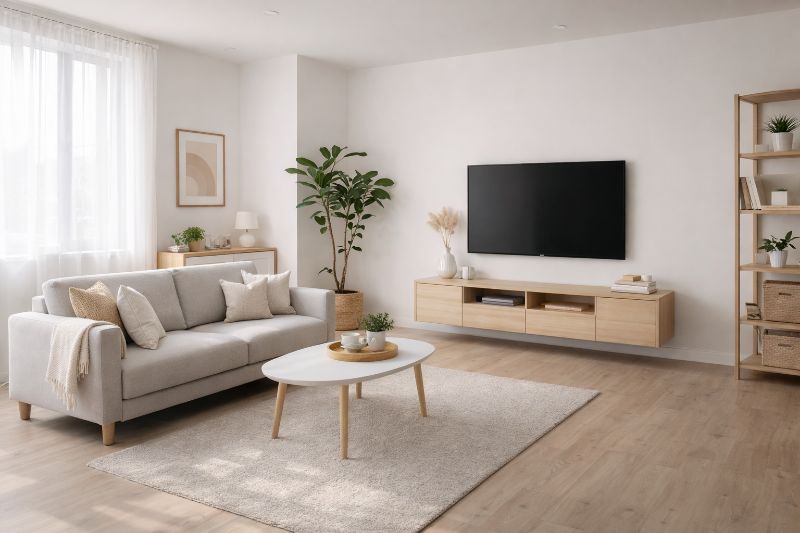
No room in a home gets more competing demands than the living room. It is expected to feel welcoming to guests, comfortable for daily use, aesthetically coherent in photographs, and personally expressive — all at once. The rooms that achieve this balance rarely happen by accident.
Start with the Anchor Piece
Every successful living room is organized around an anchor — typically a sofa, occasionally a fireplace or a significant piece of art. Everything else in the room should relate to that anchor in scale, proportion, and visual weight.
“The most common mistake people make is buying furniture one piece at a time with no reference point. The room ends up feeling like a showroom sample sale rather than a home.”
If you’re starting from scratch, invest most of your budget in the anchor piece. A quality sofa in a neutral that can absorb different accessory cycles will serve you for a decade. Trend-responsive accent pieces are much cheaper to replace.
The Rule of Proportion
Scale is the most underappreciated factor in room composition. A rug that is too small for the seating arrangement is one of the most common errors in residential interiors — it makes the space feel unresolved even when the individual pieces are good.
As a general principle: the rug should be large enough that at least the front legs of every major seating piece sit on it. In a typical living room, this usually means a 240 x 300 cm rug minimum.
Art height is the other proportion issue that consistently undermines otherwise well-considered rooms. Art hung too high — a near-universal error — disconnects it from the furniture and the human eye level. The center of a piece should sit at approximately 145–150 cm from the floor.
Light Layers
Overhead lighting alone produces flat, unflattering environments. Layering light — combining ambient, task, and accent sources at different heights — creates depth and allows the room to be adjusted for different uses and times of day.
Floor lamps positioned behind seating create a warm reading environment. Table lamps at sofa-arm height provide intimate ambient light for evening use. Accent lighting directed at art or architectural features adds depth without brightness.
Editing Is the Work
The difference between a room that feels curated and one that feels cluttered is often not the quality of the objects — it is the discipline applied to editing. Living rooms accumulate. Objects arrive for different reasons and stay out of inertia.
The practice of periodically removing everything from surfaces and returning only what genuinely belongs is more useful than any shopping trip. You often already have everything the room needs — just more of it than it can carry.
Plants and Natural Elements
Living rooms with no organic material — no plants, no natural fiber textiles, no wood grain, no stone — tend to feel sterile regardless of the quality of the furniture. A single large-format plant in a well-chosen pot contributes more visual warmth than most decorative objects.
Low-maintenance varieties — monstera, sansevieria, ZZ plant — are forgiving enough that their care doesn’t become a burden that eventually leads to their removal.
The Coherence Test
Stand in the doorway and look at the room as a whole. Does each element feel like it belongs in the same conversation as the others? If something looks like it arrived from a different story, it probably did — and the room will feel more resolved once you acknowledge that honestly.