

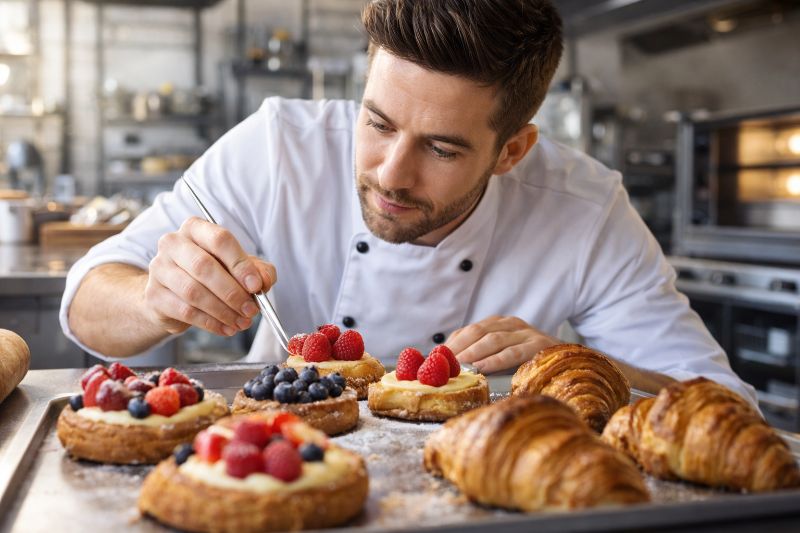
There is a reason bakers wake before dawn. The dough doesn’t care about your schedule — it moves on its own time, rising and resting according to temperature, humidity, and the invisible choreography of yeast. Baking is one of the few culinary disciplines where precision and intuition must coexist.
The Chemistry Behind the Crust
Every baked good is a series of chemical reactions. When flour meets water, gluten networks form — stretchy protein structures that give bread its chew and pastry its structure. The ratio of flour to fat to liquid determines whether you end up with a crumbly shortcrust or a layered puff pastry.
“Baking is chemistry you can eat. Get the ratios wrong and the whole thing collapses — literally.”
Fat plays an especially critical role in pastry. Butter, with its distinct water content and flavor compounds, behaves very differently from shortening or lard. When cold butter is layered into dough and exposed to oven heat, the water in the butter converts to steam — creating those coveted flaky layers.
Temperature Is Everything
Professional pastry chefs obsess over temperature at every stage. Cold hands, chilled bowls, and refrigerated butter are not affectations — they prevent the fat from melting prematurely into the dough. A warm kitchen can undo an hour of careful lamination in minutes.
Oven temperature is equally critical. A too-cool oven lets pastry spread before it sets. A too-hot oven burns the exterior before the interior cooks through. Most professional ovens are calibrated regularly; home bakers should invest in an oven thermometer.
Mastering the Basics Before the Complex
Experienced pastry chefs universally recommend mastering foundational doughs before attempting advanced techniques:
- Shortcrust — the gateway pastry. Forgiving, versatile, and a perfect teacher of fat-to-flour ratios.
- Choux — teaches how steam leavens dough, a principle used in éclairs and profiteroles.
- Croissant dough — the advanced class. Requires precise lamination, consistent temperature control, and patience across multiple days.
Each dough teaches a different principle. Rush the sequence and the lessons don’t stick.
The Role of Resting
Resting dough is not optional. When gluten is worked, it becomes tense and elastic — rolling it out immediately causes it to spring back. A rest in the refrigerator relaxes the gluten, makes the dough easier to handle, and improves the final texture.
For enriched doughs like brioche, an overnight cold fermentation also develops flavor compounds that no shortcut can replicate.
Scaling and Precision
Unlike cooking, where improvisation is often rewarded, baking punishes guesswork. A 10% variation in flour can mean the difference between a tender crumb and a dense brick. Professional bakers weigh every ingredient — volume measurements like “a cup of flour” vary too much depending on how the flour is scooped.
If you take one upgrade seriously in your home baking setup, make it a digital scale.
The Patience Principle
More than technique, more than equipment, the defining quality of a great baker is patience. Rushing a proof, skipping a chill, or pulling something from the oven five minutes early — these shortcuts accumulate into mediocre results.
The perfect pastry rewards those willing to follow the process all the way through, even when the clock says otherwise.