

When OpenAI released GPT-2 in 2019, the company famously withheld the full model, fearing misuse. Six years later, models exponentially more powerful are embedded in hospital diagnostic systems, legal research platforms, financial risk engines, and middle-school homework helpers. The revolution did not arrive with fanfare — it arrived as a Tuesday product update.
The Quiet Takeover of Professional Work
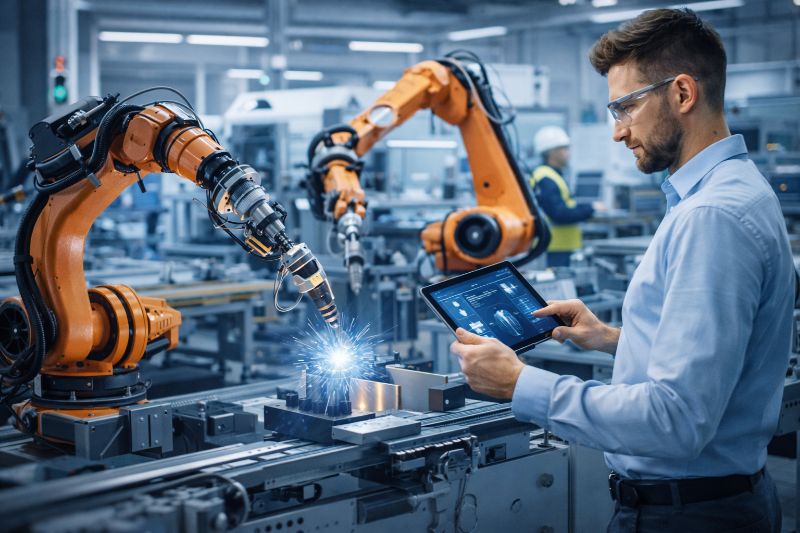
The most profound changes are happening not in Silicon Valley labs, but in everyday professional workflows. Law firms are deploying LLMs to process thousands of pages of discovery documents in hours. Radiologists use AI to flag anomalies in imaging scans. Architects feed rough sketches into generative models and receive fully rendered drafts in seconds.
“We used to spend three days on a standard due diligence report. Now it takes four hours — with higher accuracy.” — Partner at a London law firm
The pattern repeats across every domain: tasks that required specialist time and expertise are being dramatically compressed.
Healthcare: The Most Consequential Deployment
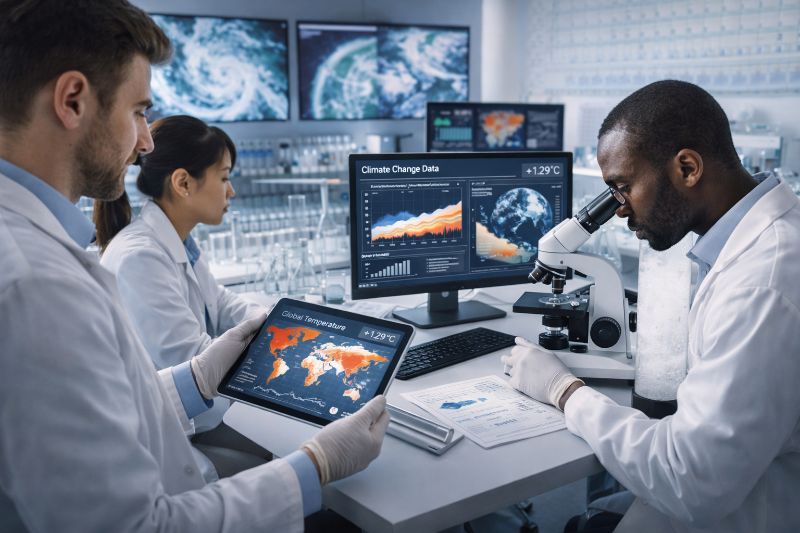
Perhaps nowhere is the transformation more significant — or more fraught — than in medicine. Studies published in The Lancet and NEJM have demonstrated that certain AI diagnostic models match or exceed the performance of experienced clinicians on specific tasks like detecting diabetic retinopathy, identifying cancer in pathology slides, and predicting sepsis onset.
But deployment at scale requires more than accuracy. It requires trust, regulatory approval, liability frameworks, and integration into existing clinical infrastructure — all of which are still catching up with the technology’s capabilities.
The Labor Question Nobody Wants to Answer
Economists are divided. Some argue AI will follow the historical pattern of general-purpose technologies — displacing certain tasks while creating new categories of work. Others point to the unprecedented breadth of AI’s capabilities as qualitatively different from past automation waves.
What is clear: the transition will not be evenly distributed. Workers in data-heavy, routine cognitive roles face the sharpest near-term disruption. Highly creative, deeply relational, and hands-on physical roles appear more resilient — for now.
Regulation Races to Keep Up
The EU AI Act, now partially in force, has created the world’s first comprehensive regulatory framework for artificial intelligence. The United States has taken a more fragmented approach, with sector-specific guidance from agencies including the FDA, SEC, and EEOC.
China has implemented its own Generative AI Regulations, requiring content labeling and algorithmic transparency from major platforms.
The challenge for regulators is fundamental: the technology evolves faster than legislation can be drafted, debated, and enacted.
What Comes Next
The next frontier is not larger language models — it is more capable reasoning models: systems that can plan multi-step tasks, use external tools, verify their own outputs, and collaborate with other AI agents. Early versions are already deployed in enterprise settings.
The coming two years will likely determine whether AI development continues to accelerate, or whether alignment challenges, regulatory friction, and infrastructure limits create a natural plateau.
Either way, the world built around the assumption that cognitive work requires human intelligence is already gone. We are building its successor in real time.