


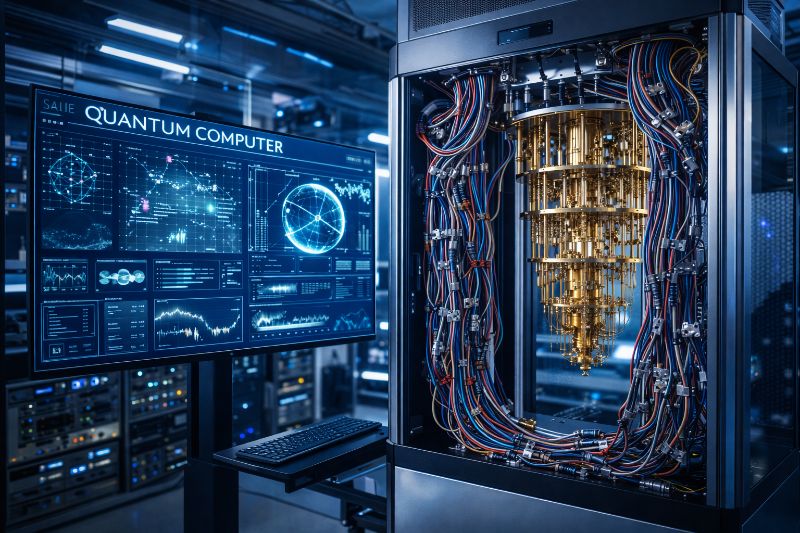
For decades, quantum computing existed primarily as a promise — a theoretical framework with breathtaking potential and a stubborn inability to perform useful work outside carefully controlled laboratory conditions. That picture is changing with unusual speed.
What Has Changed
The core challenge in quantum computing has always been decoherence: quantum bits, or qubits, lose their quantum state when they interact with their environment, introducing errors that render calculations unreliable. Recent progress on error correction — the techniques that detect and fix these errors in real time — has moved faster than most researchers anticipated.
Several research teams have now demonstrated processors capable of maintaining quantum states long enough to run algorithms that would take classical supercomputers an impractical amount of time to complete. The gap between laboratory demonstration and practical deployment is narrowing.
Why It Matters
The applications are not narrow. Quantum computers are particularly well-suited to simulating molecular interactions at a level of precision that classical computers cannot match. This makes them transformative for drug discovery — a process currently limited by our ability to model how candidate molecules behave in biological systems.
“We are not replacing classical computers. We are adding a fundamentally different kind of computational tool that excels at a specific class of problems classical machines handle poorly.”
Cryptography is the more immediately disruptive application. Most current encryption standards rely on mathematical problems that are computationally intractable for classical hardware. A sufficiently powerful quantum computer would break them. The cryptographic community is already developing post-quantum encryption standards in anticipation — but the transition will take years and requires infrastructure upgrades across industries.
The Road Ahead
The current systems are noisy and require near-absolute-zero operating temperatures, making them expensive and logistically demanding. Scaling from hundreds to millions of stable qubits — the threshold estimated for many commercially significant applications — remains a formidable engineering challenge.
What has shifted is the credible timeline. The consensus view among researchers has moved from “eventual” to “imminent for specific applications.” Organizations with long planning horizons — governments, financial institutions, pharmaceutical companies — are already treating quantum readiness as a strategic priority.