


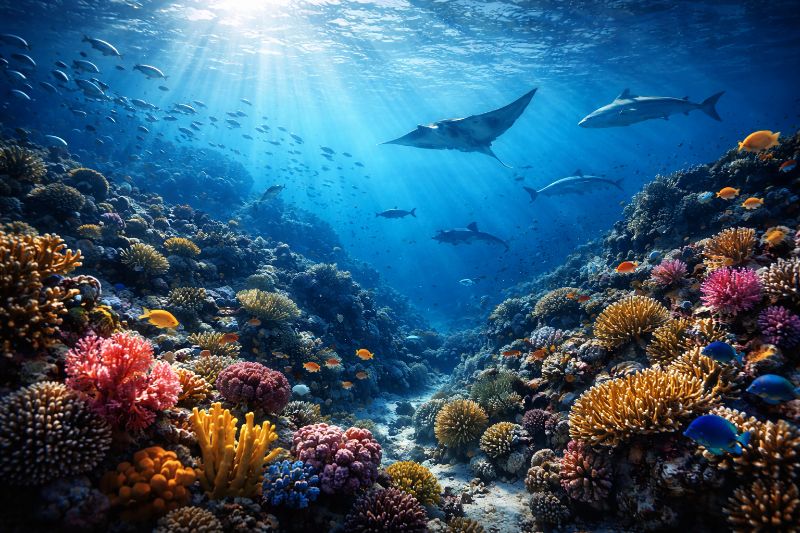
More than eighty percent of the ocean floor has never been mapped, imaged, or directly explored. The deep sea — broadly defined as the zone below 200 metres where sunlight cannot penetrate — covers more of Earth’s surface than all of the continents combined, and until recently we knew almost nothing about what lived there.
Life Without Sunlight
The discovery of hydrothermal vent ecosystems in the late 1970s fundamentally changed biology. In environments that are superheated, chemically toxic, and completely dark, dense communities of organisms were found thriving through chemosynthesis — using chemical energy from the vents rather than sunlight — rather than photosynthesis.
These ecosystems are not marginal curiosities. They host hundreds of species found nowhere else, have generated new hypotheses about the origin of life on Earth, and have significant implications for the search for life elsewhere in the solar system. Europa and Enceladus, the moons of Jupiter and Saturn respectively, are believed to harbor subsurface oceans with hydrothermal activity. If life can sustain itself in comparable conditions on Earth, the case for life elsewhere improves substantially.
What Recent Expeditions Are Finding
Contemporary deep-sea research has moved beyond cataloguing organisms to understanding the ecological and chemical systems they participate in. Several findings from expeditions over the past three years stand out.
Researchers have documented organisms with biological clocks synchronized not to light cycles but to pressure changes — an entirely novel form of environmental timekeeping. Carbon cycling in the deep ocean is proving to be far more active than models had assumed, with implications for climate projections that depend on accurate estimates of oceanic carbon sequestration.
New species continue to be found at a rate that surprises even specialists. A single expedition to uncharted deep-water regions will typically document dozens of species unknown to science.
The Preservation Question
The same remoteness that has kept the deep ocean largely unknown has also kept it largely intact. That is changing. Deep-sea mining — for rare earth metals concentrated in nodules on the ocean floor — is moving from proposal to pilot operations. The ecological baseline for much of the deep ocean has never been established, which means we may be beginning to degrade systems we do not yet understand.