

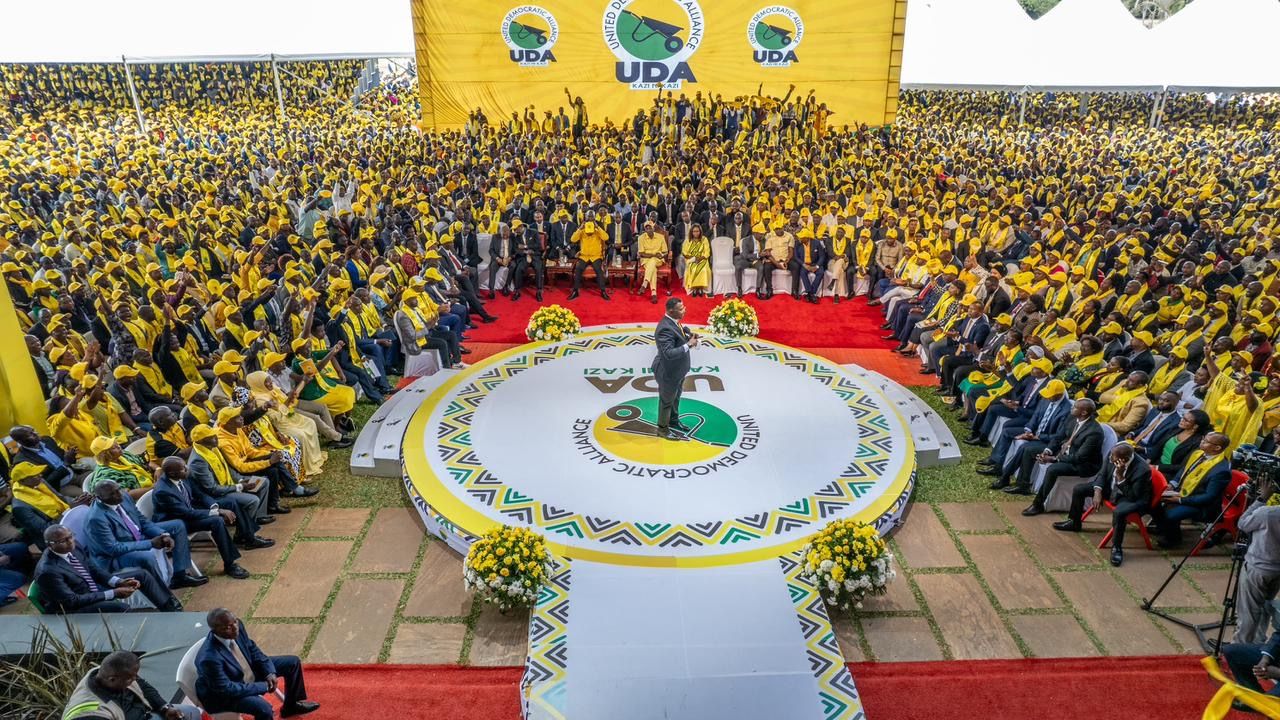
The ruling United Democratic Alliance, UDA, heads into Thursday’s grassroots elections facing what may be its most consequential internal political test yet - proving that it can turn state power into durable party structures, not just national visibility.
Across the country, the ruling party says more than 450,000 candidates have been cleared to contest in an exercise expected to draw about eight million voters at over 9,000 polling centres.
The party is framing the vote as one of the largest internal democratic exercises mounted by a Kenyan political outfit, with 20 positions up for election at the polling centre level and a projected 182,240 grassroots representatives expected to emerge once the current phase is complete. UDA says the process will be backed by 9,500 electronic voting tablets, with results set to be published through its official portal.
However, beyond the numbers, the real political story on Thursday is not just administrative scale. It is urgency.
For UDA, these elections are a race against time to build a real party machine ahead of the next general election cycle, especially in regions where its national appeal has long been contested.
That is why the focus on Migori, Kisumu and Siaya matters far beyond party paperwork. In those counties, UDA is not simply electing officials. It is trying to demonstrate that its reach can extend into areas long viewed as opposition bastions, and that its promise of being a national party can survive direct competition on the ground.
That pressure was visible even in the party’s own messaging ahead of the vote. On its official platform, UDA has openly urged members to “become a UDA official by participating in the upcoming grassroots election,” signalling how central this process is to the party’s wider project of institutional expansion. 
In political terms, this is the moment where slogans must give way to structure.
For months, Kenyan politics has been dominated by alliances, tensions, tactical truces and shifting regional calculations. But parties live or die not only by high-level negotiations in Nairobi, but by the presence of actual ward, polling centre and local delegates who can organise voters, defend party positions and mobilise at election time. UDA understands that risk. A party that controls the national government but lacks rooted local organs in critical counties risks looking broad on paper and brittle on the ground.
That is why Thursday’s polls carry an unmistakable message: UDA cannot afford a weak, chaotic or low-turnout process.
The party has already conducted similar grassroots elections in 25 counties and says more than 235,000 officials have been elected so far.
The current repeat Phase II exercise is meant to deepen that foundation and close gaps left by earlier phases. In that sense, the vote is not only a sign of expansion but also of consolidation. The party is trying to show that it can run a structured, repeatable, tech-enabled internal election system across diverse regions, not just hold headline-grabbing events.
UDA Chairperson Cecily Mbarire said voting would run from 8am to 5pm, underscoring the party’s effort to present the exercise as orderly and standardised.
The party has also said end-to-end technology will be used at polling centres, with results uploaded to a public-facing platform after tallying.
In Kisumu, where the exercise carries obvious symbolic and political weight, local officials have sought to reassure members that preparations are complete.
County Returning Officer Charles Mundia said materials were being distributed ahead of the poll and that, “Voting will start at 8am and run until 5pm, and no voter will be left out.” He said
580 tablets would be deployed across more than 500 polling stations in the county.
Mundia also gave away the deeper concern driving the process in Nyanza: credibility. He said the electronic system was designed to address challenges reported in earlier phases in other parts of the region, including delays and logistical hitches.
“This is not a repeat election. It is the first time we are conducting the exercise in Kisumu, and the organisation is different because the process is electronic,” he said.
That statement is politically significant. It suggests UDA is aware that in counties like Kisumu, Migori and Siaya, process matters as much as turnout.
A flawed election would hand critics an easy argument that the party’s national language outpaces its organisational discipline. A smooth election, by contrast, would allow UDA to claim that internal democracy, transparency and participation are not just talking points but operational realities, even in politically sensitive territory.
The Nyanza front is especially important because it cuts to one of the oldest assumptions in Kenya’s electoral politics: that some regions are effectively closed political ecosystems. UDA’s decision to visibly organise in Migori, Kisumu and Siaya challenges that notion, not through rhetorical confrontation but through structured competition. That is the significance of these polls.
The party is attempting to shift the conversation from inherited political identity to open participation, from presumed loyalty to earned support.
Historically, grassroots party elections in Kenya have often been overshadowed by disputes over zoning, patronage, elite consensus and the quiet allocation of positions before members ever vote. UDA is trying to present a different image, one built around open contest, visible procedure and technology-backed transparency. Whether the exercise fully meets that standard will be judged not by press statements, but by what members experience at polling centres.
There are already signs of both promise and pressure. In Kisumu, officials have pushed voter sensitisation and said no voter should be excluded, while some members have also raised concerns over communication gaps and access to polling stations.
Acting county vice chairperson Beatrice Amondi moved to calm those fears, saying the exercise would be peaceful, free and fair.
Those concerns are not peripheral. They go to the heart of the urgency facing UDA.
A party seeking to brand itself as mature, national and institutionally coherent must show that its systems can hold under pressure, particularly where scepticism is high. In practical terms, that means polling stations opening on time, gadgets working, voter information flowing clearly, disputes being handled quickly and results being uploaded without confusion. It also means avoiding the temptation to turn the exercise into a triumphalist political spectacle. The smarter play for UDA is exactly what its own communication framing suggests - focus on process, participation and public confidence.
That may be the clearest lesson of Thursday’s vote.
For UDA, the win is not merely in how many officials are elected. The win is in whether ordinary members, especially in counties such as Migori, Kisumu and Siaya, come away believing the process was open, orderly and worth showing up for. If they do, UDA will have gained more than local officials. It will have gained proof that it can plant roots where many assumed it could only make noise.
If it fails, the damage will also run deeper than one day’s embarrassment. It would reinforce the idea that the party’s national expansion remains top-heavy, dependent on state power and elite messaging rather than genuine local buy-in.
This is not just a party election. It is a stress test of UDA’s organisational seriousness, a credibility check on its democratic claims and a referendum on whether the ruling party can build from the ground up in places where history has rarely moved in its favour. In that sense, the urgency for UDA is plain: if it wants to be seen as a truly national party by 2027, the groundwork has to look real in 2026.