
Kenya has formally concluded its participation in the Multinational Security Support, MSS, mission in Haiti, marking the end of a high-profile deployment that placed Kenyan police officers at the centre of an international effort to restore security in the violence-hit Caribbean nation.
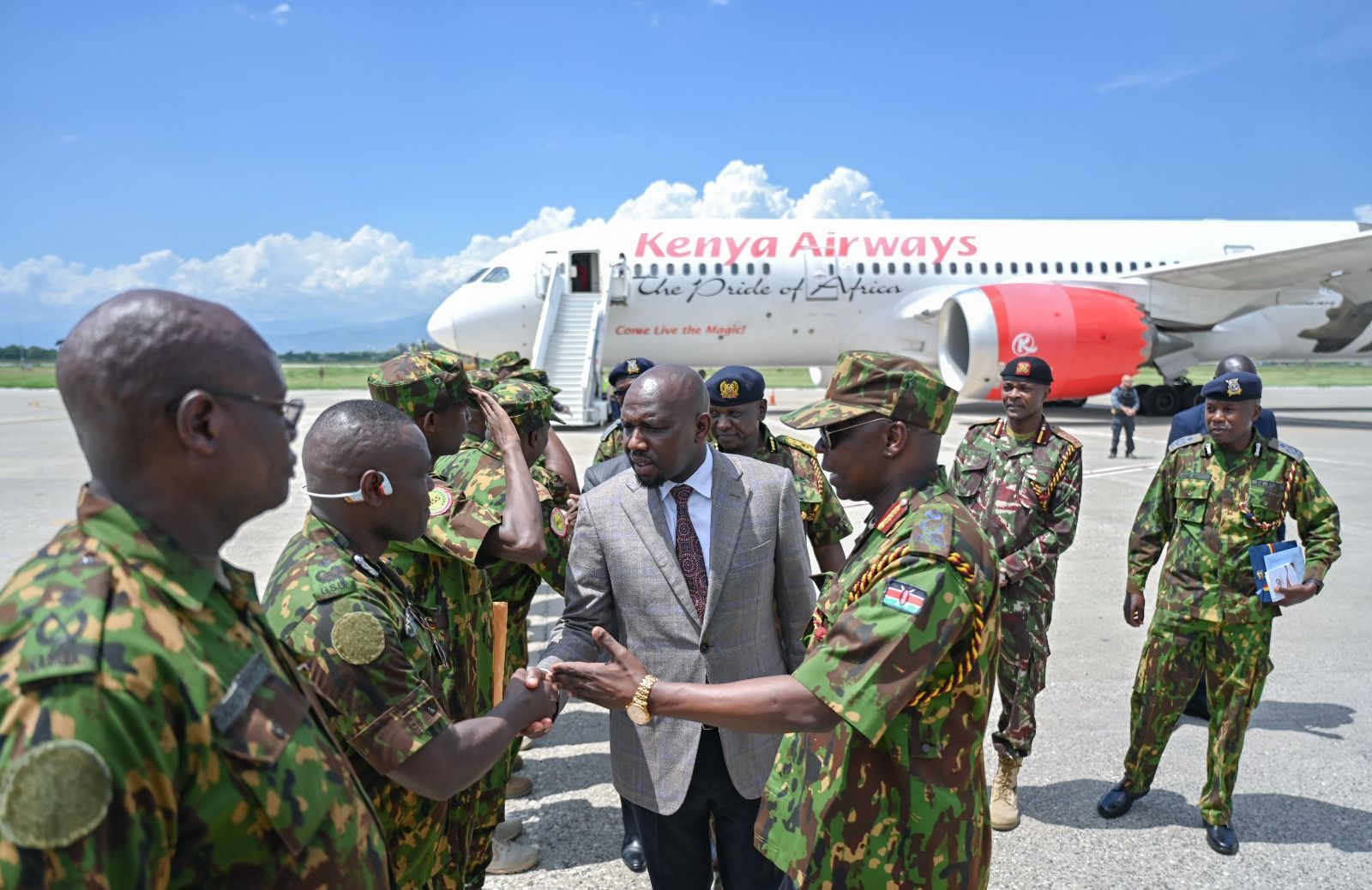
Interior Cabinet Secretary Kipchumba Murkomen led a Kenyan delegation to Port-au-Prince for the final drawdown of the Kenyan contingent, which took place on April 27, 2026, at Toussaint Louverture International Airport. He was accompanied by Inspector General of Police Douglas Kanja and National Security Advisor Joseph Boinett, in a mission that signalled both the operational closure of Kenya’s deployment and a moment of reflection on the country’s role in Haiti’s security response.
“Today, a government that was once at risk of being overrun by gangs not only stands but is steadily regaining its footing. Our officers secured critical infrastructure, including the airport, seaport, and major transport corridors," said CS Murkomen.
The drawdown ends Kenya’s active participation in the MSS Mission, which was launched to support Haitian authorities in confronting heavily armed gangs that had seized control of key parts of the country, including large sections of the capital, Port-au-Prince.
Kenya had served as the lead nation in the mission, which was backed by the United Nations Security Council and supported by several international partners.
The final group of Kenyan officers departed Haiti after months of phased withdrawals, closing a deployment that began in June 2024 when the first Kenyan contingent arrived in Port-au-Prince. The mission was initially framed as a stabilization effort to help the Haitian National Police regain control of critical infrastructure, reopen transport routes, and restore a measure of public order in areas where gang activity had disrupted daily life.
“They conducted joint operations, restored state presence in previously inaccessible areas, and supported the reopening of schools, hospitals, and businesses. In many neighborhoods, families have begun returning to homes they had abandoned. Commerce is gradually picking up. Confidence in public institutions is being rebuilt," he added.
Kenya had pledged to send 1,000 police officers to the mission. However, the number of officers deployed reached about 730 due to logistical and operational constraints, according to details attributed to the Kenyan delegation during the drawdown event. The deployment included officers who worked alongside the Haitian National Police and personnel from other contributing countries, including nations from the Caribbean and Latin America.
“These achievements were realized despite significant personnel, logistical, and material constraints. At its peak, the Mission deployed fewer than 1,000 personnel against an authorized strength of 2,500, largely due to limitations in infrastructure. Yet, even within these constraints, the Mission delivered meaningful results," said Murkomen.
During the final send-off, the Kenyan delegation was received by senior mission officials, including MSS Contingent Commander Godfrey Otunge and Kenya’s Consular General for Haiti, Noor Gabow.
Murkomen was briefed on the mission’s activities, operational milestones and the transition from the MSS framework to the Gang Suppression Force, a new security arrangement authorised under United Nations Security Council Resolution 2793 of 2025.
The transition to the Gang Suppression Force marks a new phase in Haiti’s international security support. The new arrangement is expected to be larger and more robust than the MSS Mission, with a mandate designed to strengthen operations against gangs that continue to control territory, disrupt public services and threaten civilians. The United Nations Security Council authorised the transition in September 2025, replacing the Kenya-led MSS framework with a wider multinational structure.
Kenya’s withdrawal comes at a delicate moment for Haiti, where security conditions remain fragile despite reported gains in some areas. Armed gangs continue to pose a major threat to civilians, state institutions, transport corridors, ports, markets, schools and hospitals.
The crisis has deepened over several years, particularly after the 2021 assassination of President Jovenel Moïse, which worsened political instability and created room for armed groups to expand their influence.
According to the United Nations Office on Drugs and Crime, gangs have taken control of vast areas of Haiti, including an estimated 80 to 90 percent of Port-au-Prince, while also dominating key supply routes and extorting commercial and humanitarian movement. The UN agency says the country’s strategic location, weak border controls, porous ports and trafficking routes have made it vulnerable to the flow of illicit firearms, ammunition and other contraband.
The humanitarian impact has been severe. By early 2026, more than 1.4 million people had been displaced by gang violence, while millions more needed humanitarian assistance. Aid agencies have warned that civilians continue to face killings, kidnappings, sexual violence, hunger, forced displacement and limited access to health care, education and clean water.
For Kenya, the mission represented one of its most visible international security deployments in recent years. It was presented by the government as an expression of Kenya’s commitment to multilateral cooperation, global peace and solidarity with countries facing severe instability. It also positioned Kenyan police officers in a complex foreign security environment, far from familiar operational terrain and under close international scrutiny.
“It is regrettable that allegations of misconduct arose during the mission. We took these allegations seriously. A board of Inquiry was established, findings were communicated to relevant authorities, and the government of Kenya engaged with the United Nations accordingly," assured the Cabinet Secretary.
The mission, however, was not without controversy. Before and during the deployment, questions were raised in Kenya over the legal basis of sending police officers abroad, the risks involved, the welfare of officers, funding arrangements and whether Kenya should have taken the lead in a crisis so far from home. Critics also questioned whether the mission had adequate personnel, equipment and resources to confront heavily armed gangs operating in dense urban areas.
Despite the concerns, Kenyan officials have maintained that the country’s officers made an important contribution to stabilization efforts in Haiti. They have pointed to the securing of critical infrastructure, including the airport, seaport and major transport corridors, as among the mission’s key achievements. Kenyan authorities have also said the deployment helped support the gradual return of some public services, including schools, hospitals and businesses in areas previously affected by gang disruption.
The mission also carried a human cost. Three Kenyan officers died during the deployment, a loss that has remained central to the national conversation around Kenya’s participation in the Haiti operation. During the drawdown, Murkomen paid tribute to the fallen officers and recognized the service of those who had been deployed under difficult conditions.
Inspector General Kanja also commended the returning officers for their discipline and professionalism, urging them to apply the experience gained in Haiti to strengthen policing at home. The Haiti deployment exposed Kenyan officers to international policing, joint operations, urban stabilization, critical infrastructure protection and cooperation with foreign security agencies.
“To the Government and people of Haiti, we say this: your resilience is unmistakable. Time and again, you have demonstrated the strength to overcome adversity. There is no clearer symbol of that resilience than your qualification for the 2026 FIFA World Cup after 52 years - achieved under extraordinary circumstances. Kenya will be cheering you on," added CS Murkomen
For Kenya, the final drawdown closes a chapter that tested the country’s policing capacity, diplomatic posture and appetite for global security leadership.
As the last officers return home, the mission will likely be assessed not only by what it achieved on the ground, but also by the lessons it offers for future deployments.
Follow our social media pages for breaking news updates, in-depth stories and videos.
news@nairobilens.ke