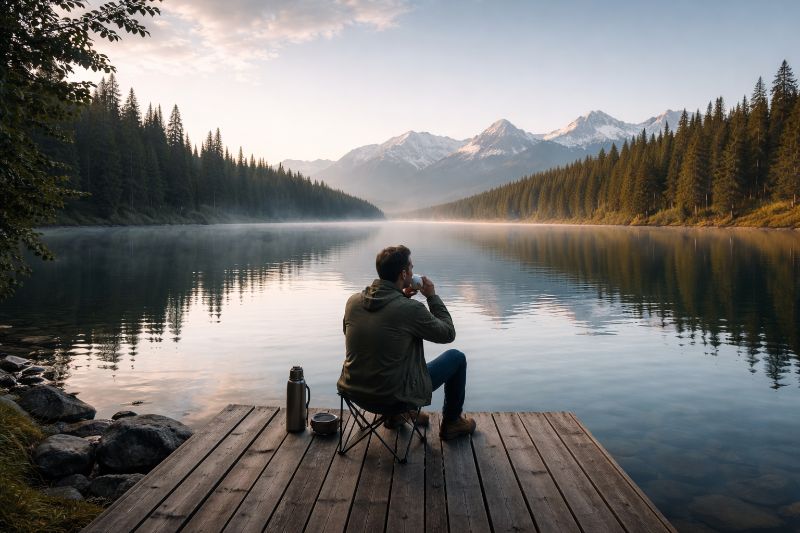



The most common misconception about photography is that better equipment produces better photographs. It can — at the margins, in specific technical situations. But the images that stop people scrolling, the ones that carry genuine emotional weight, are almost never the result of superior hardware. They are the result of decisions: where to stand, when to press the shutter, what to include and what to exclude from the frame.
Light Is Everything
Photography is, etymologically, writing with light. Every other technical consideration — aperture, shutter speed, ISO — is ultimately a way of managing the light available to the sensor. Understanding light is the foundational skill, and it is entirely independent of what camera you’re using.
“Amateur photographers spend money on lenses. Serious photographers spend time finding good light.”
The golden hours — the period shortly after sunrise and before sunset — produce warm, directional light that flatters almost any subject. The quality of light in these windows is qualitatively different from midday light, which is harsh, overhead, and unflattering for portraits and most landscape work.
Overcast days produce soft, diffused light that works beautifully for portraits and close-up work — the clouds act as an enormous softbox, eliminating the hard shadows that direct sunlight creates.
Composition Before Capture
Most photographs are taken too quickly. The instinct to capture a moment before it disappears is understandable, but it produces images where the composition hasn’t been considered. Taking an extra two seconds to think about framing before pressing the shutter consistently improves results.
The rule of thirds — dividing the frame into a three-by-three grid and placing key subjects at the intersection points rather than dead center — produces more dynamic compositions than centered framing in most situations. It is a guideline, not a rule, and the most interesting photographers know when to break it deliberately.
Foreground interest transforms landscape photography. Including an element in the near foreground creates depth and draws the eye into the image in a way that a simple horizon shot does not.
The Decisive Moment
Henri Cartier-Bresson’s concept of the decisive moment — the instant when the formal elements of a scene align with its emotional content — remains the most useful framework for thinking about when to press the shutter in candid and street photography.
In practice, this means watching rather than just looking. Understanding what is happening in front of you well enough to anticipate when the gesture, the expression, or the juxtaposition will be at its most resonant. Most photographers who produce strong work take many more frames than they show — the decisive moment is found in editing as much as in capture.
Technical Fluency Without Technical Obsession
Understanding exposure — the relationship between aperture, shutter speed, and ISO — gives you creative control over your images. A wide aperture blurs backgrounds and isolates subjects. A fast shutter speed freezes motion. A slow shutter speed creates motion blur that implies movement and energy.
These tools are worth learning. They are not worth obsessing over at the expense of the more important questions of light, composition, and moment.
The Post-Processing Question
Editing is part of the photographic process, not a corruption of it. Every film photograph was processed; every digital photograph involves algorithmic decisions in the camera before the file is written. The question is not whether to edit but how much and toward what end.
Subtle adjustments — exposure correction, white balance, contrast — that serve the image as it was captured are different from heavy manipulation that creates an image the scene never contained. The best editing is invisible: it removes distractions and emphasizes what was already there.
Developing an Eye
The photographers who improve fastest are those who look at a lot of photographs — critically, analytically, asking what makes specific images work. Building a visual vocabulary through study of photographers whose work you admire gives you a reference library for your own decision-making in the field.
The camera is a tool. The eye behind it is the work.