

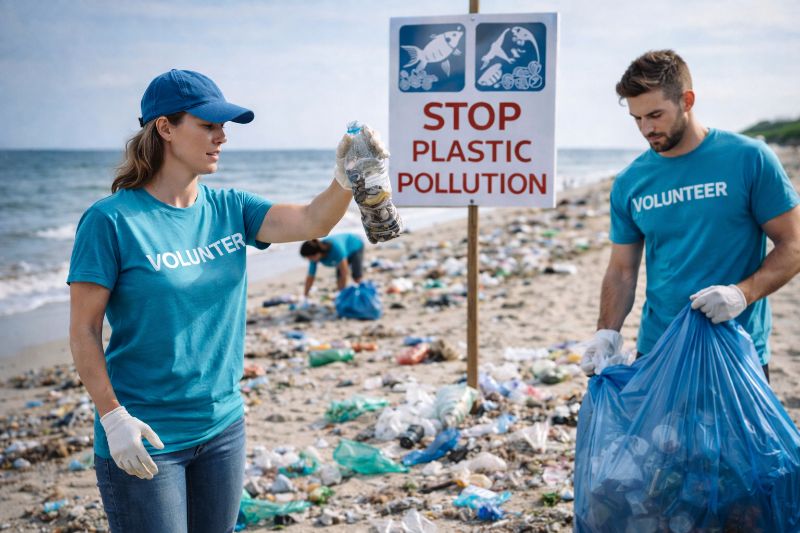
Every minute, the equivalent of a garbage truck’s worth of plastic enters the world’s oceans. The statistic has been repeated enough to have lost some of its shock value, but the underlying reality it describes has not improved — it has accelerated.
The Scale of the Problem
Global plastic production exceeded 400 million tonnes in 2023, with projections suggesting it will double again by 2040 if current trends continue. Of the plastic produced since industrial manufacturing began, less than 10% has been recycled. The majority has been landfilled, incinerated, or has entered natural environments.
“Recycling is necessary but not sufficient. The fundamental problem is production volume. We cannot recycle our way out of a production problem.”
Single-use plastic — packaging, bags, bottles, cutlery, straws — accounts for roughly half of all plastic waste by volume. It is also the category where alternatives exist and regulatory intervention has produced measurable results.
What Individual Action Actually Does
The “reduce, reuse, recycle” framework has been criticized for placing responsibility on consumers for a problem that is primarily structural. That critique has validity: the ten largest plastic polluters are corporations, not individuals, and legislative change targeting production and packaging mandates would have far greater impact than any consumer behavior shift.
That said, individual choices are not meaningless. Consumer demand shapes production incentives. Purchasing decisions, at aggregate scale, affect what gets made. And habits built around reduced consumption — carrying a reusable bottle, refusing single-use packaging, choosing products with minimal packaging — change the personal relationship with disposability in ways that can translate into political engagement.
Regulatory Progress
Several significant regulatory developments have occurred in the past two years. The EU Single-Use Plastics Directive has banned or restricted the most common beach-litter items across member states, with measurable early results in coastal monitoring data. Several Southeast Asian economies — historically among the largest ocean plastic contributors due to inadequate waste management infrastructure — have introduced extended producer responsibility legislation that shifts collection and processing costs onto manufacturers.
The proposed UN Global Plastics Treaty, currently in negotiation, would represent the most significant international policy framework for plastic reduction if concluded. Early draft texts suggest ambition; the gap between ambition and binding commitment remains the core challenge.
Practical Transitions
For individuals and households looking to reduce plastic footprint without significant lifestyle disruption, the highest-impact changes are typically:
- Eliminating single-use plastic bottles through a quality reusable alternative
- Shifting to bar soap and shampoo bars, which eliminate pump-bottle packaging
- Choosing loose produce over pre-packaged alternatives where available
- Declining plastic bags consistently and carrying alternatives
- Selecting products with recyclable or minimal packaging when choices are equivalent
These are not transformative on their own. Combined with consumer advocacy and political engagement on production-side regulation, they are part of a coherent approach.
The Sustainable Life as Ongoing Practice
Sustainability is a direction rather than a destination — a continuous process of reducing harm, not a binary state of purity or failure. The perfectionism that leads people to disengage from environmental practice because they cannot achieve complete consistency is a more significant obstacle than occasional lapses.
The fight against plastic pollution needs both systemic change and individual engagement. Neither alone is sufficient.