

Credit: AFP
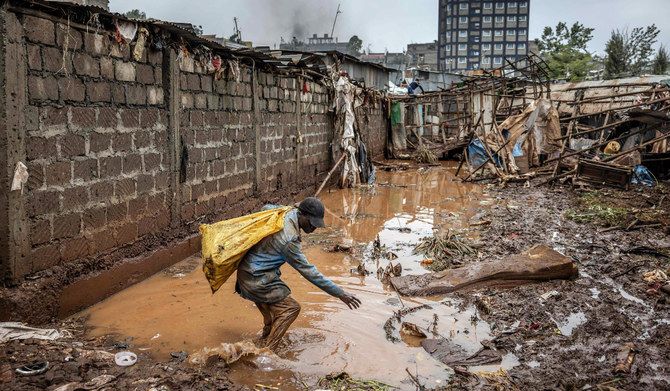
As floodwaters continue to wreak havoc in Nairobi and across Kenya, a growing number of experts are warning that the capital’s latest disaster cannot be blamed on climate alone. While intense rainfall has played a major role, specialists say years of poor urban planning, blocked drainage, loss of green spaces and weak enforcement against illegal construction have turned heavy rain into a deadly urban crisis.
The renewed debate comes as the national flood death toll continues to rise. Reuters reported on March 28 that at least 108 people had died in the country after weeks of heavy rainfall since March 6, with thousands of families displaced and key infrastructure damaged. Earlier reporting showed Nairobi was among the hardest-hit areas, with the city accounting for a large share of the deaths recorded in the first wave of flooding.
Weather experts say the rains were serious, but not entirely unforeseen. The Kenya Meteorological Department had projected near- to above-average rainfall for some regions during the March-April-May long rains season and warned that scattered heavy rainfall events were likely to occur. That warning has strengthened the argument that the real failure lay not only in the weather itself, but in how Nairobi prepared, or failed to prepare, for it.
Urban planning experts and environmental analysts say Nairobi’s built environment has become increasingly hostile to flood management. Nation and The Star have reported that unchecked development on riparian land, clogged drainage systems, narrowing waterways and the spread of concrete surfaces have severely reduced the city’s ability to absorb or channel stormwater safely. In some neighbourhoods, natural drainage paths have been blocked or built over, leaving floodwater with nowhere to go except into homes, roads and businesses.
Other experts point to the disappearance of Nairobi’s green spaces as a critical factor. Standard reported that environmental specialists linked many flood deaths to the loss of absorbent land and open spaces that once helped slow runoff and reduce pressure on drainage systems. As urban expansion has intensified, those protective buffers have steadily disappeared.
That is why the current flooding is increasingly being described as both a climate event and a governance failure. Climate change may be increasing the intensity and unpredictability of rainfall, but experts argue that better planning, stronger enforcement and more resilient infrastructure could have prevented much of the destruction. Reuters, citing climate scientists and prior attribution research, noted that global warming has made devastating rainfall events in East Africa more likely. But in Nairobi, the scale of the damage is also forcing a harder question: whether the city is being overwhelmed by nature, or by years of man-made neglect.