

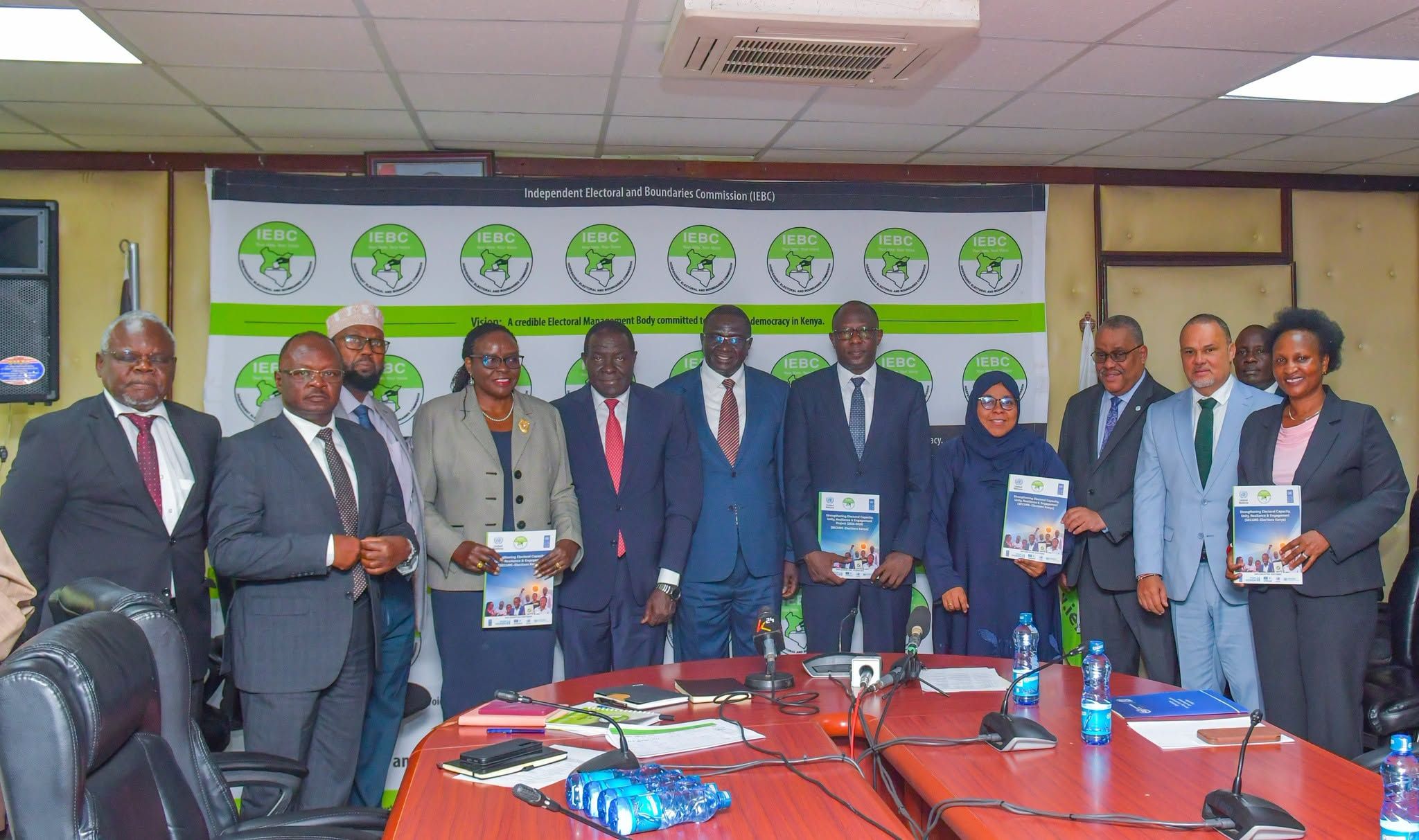
The Independent Electoral and Boundaries Commission (IEBC) has warned that escalating hate speech, political intolerance and ethnic incitement could undermine preparations for a credible and peaceful 2027 General Election.
IEBC chairperson Erastus Ethekon said the electoral commission cannot conduct elections in a climate characterized by hostility, violence and division.
“I would like to state clearly that IEBC cannot hold elections in a toxic environment,” Ethekon said.
“IEBC cannot hold elections in an environment that is full of incitement, division, violence, chaos and anarchy.”
The warning was issued jointly by the IEBC, the National Cohesion and Integration Commission (NCIC), the Office of the Registrar of Political Parties, the Ethics and Anti-Corruption Commission (EACC), the National Police Service and the Communications Authority of Kenya.
The agencies expressed concern over what they described as an alarming decline in political decency across the country in recent months.
They said public meetings and digital platforms had increasingly become channels for hate speech, ethnic contempt, vulgar language and political intolerance.
“Left unchecked, this trend sets the nation on a dangerous and unacceptable trajectory,” the agencies said in a joint statement.
They pledged to work together to protect national unity, promote peaceful coexistence and secure a credible, violence-free electoral environment ahead of the next General Election.
The institutions warned that political disagreements were increasingly being framed in language that dehumanizes opponents and portrays entire communities as enemies.
They said such rhetoric risks reversing years of progress made in building cohesion among Kenya’s diverse communities.
“Hate speech is not free speech; it is an assault on human dignity and on the constitutional order that binds this nation together,” the statement said.
The agencies noted that Kenya had previously experienced the consequences of divisive political rhetoric and warned that the country could not afford to return to that path.
NCIC and relevant law enforcement bodies have already opened investigations into several incidents, although the statement did not identify the individuals or cases under scrutiny.
The agencies said the incidents were not isolated, but appeared to form part of a broader pattern of rhetoric intended to divide Kenyans along ethnic and political lines for personal or political benefit.
They warned that investigative and enforcement powers would be used fully against individuals found to have violated the law.
While Article 33 of the Constitution guarantees freedom of expression, the agencies reminded political leaders and members of the public that the right is not absolute.
The protection does not extend to propaganda for war, incitement to violence, hate speech or advocacy of hatred that amounts to ethnic incitement, vilification or encouragement to cause harm.
The institutions also cited Articles 10 and 27 of the Constitution, which uphold national unity, human dignity, inclusiveness, equality and freedom from discrimination.
They further pointed to the National Cohesion and Integration Act, which criminalizes hate speech and the stirring up of ethnic hatred, hostility, violence and discrimination.
“Kenya is bigger and more important than any individual, community or political interest,” the agencies said.
They urged political leaders, their supporters and members of the public to exercise restraint and conduct political competition in a manner that protects the country’s peace and democratic institutions.
Follow our social media pages for breaking news updates, in-depth stories and videos.
news@nairobilens.ke