
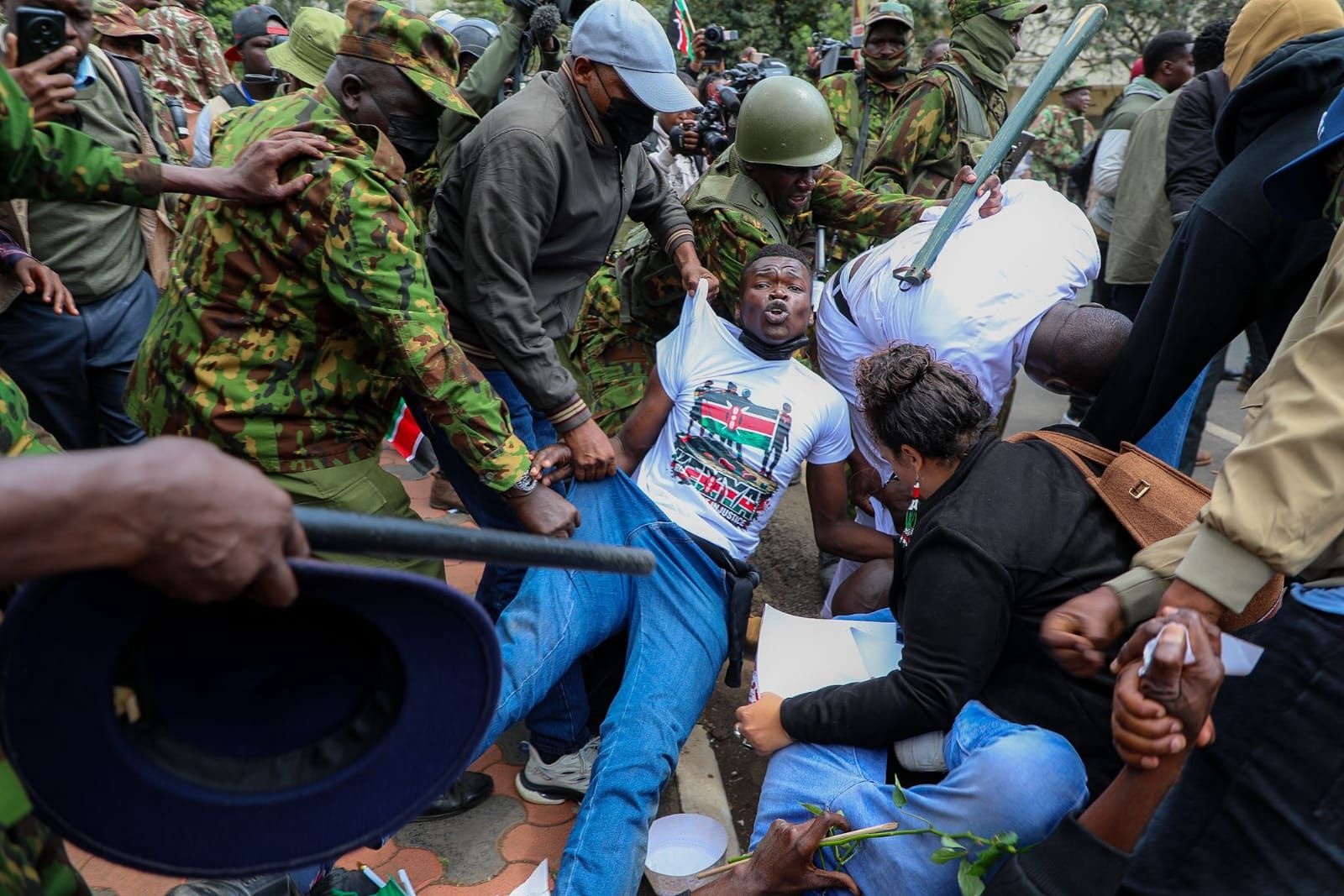
Police on Thursday locked down Nairobi’s Central Business District and restricted movement in several parts of the country as activists, families of victims and opposition leaders marked the second anniversary of the June 25, 2024 Gen Z anti-Finance Bill protests.
Access to the city centre was heavily restricted for most of the day, with officers erecting roadblocks on major routes leading into Nairobi CBD.
The security operation left key roads largely deserted, disrupted public transport and forced many commuters to seek alternative means of movement.
The commemorations were held in honor of protesters who died during the 2024 anti-Finance Bill demonstrations, which became one of the most significant youth-led protest movements in Kenya’s recent history. The protests had been sparked by opposition to tax measures and later evolved into wider calls for accountability, justice and better governance.
Police maintained a heavy presence in Nairobi and other towns, saying the operation was intended to prevent violence and protect lives and property. However, human rights activists accused authorities of using security restrictions to frustrate peaceful commemoration activities.
In Kitengela, police arrested 29 youths over allegations of incitement ahead of the planned anniversary protests. Among those arrested was Aslam Longton, one of the individuals linked to the widely publicized “Kitengela Three” case.
Police also detained a vehicle belonging to his brother, Jamil Longton, which Aslam was reportedly driving at the time of the arrest. Kajiado County Police Commander Alex Shikondi confirmed the arrests.
Human rights activist Bob Njagi was also expected to be arraigned at the Kajiado Law Courts over incitement allegations linked to the Gen Z anniversary protests.
Inspector General of Police Douglas Kanja visited Kitengela to assess the situation and said the town was calm. Kanja said the country remained safe, adding that police had received intelligence suggesting there were plans to cause violence in Nairobi CBD.
He said the decision to limit access to the city centre was based on security concerns and was meant to prevent disorder.
In Nairobi, Thika Road remained unusually quiet for much of the day. At the Carwash area in Kasarani, vehicle movement was minimal, with only a few motorists on the highway, including speeding miraa transporters.
Anti-riot police blocked major roads leading into the city centre as part of the security operation. Along the service lane, officers were seen turning back motorists and restricting access to the city. The highway, which is usually busy with matatus and private vehicles, appeared largely deserted.
With matatu operations disrupted on some routes, members of the public were forced to rely on boda-bodas as their main means of transport.
At around 1:00 PM, a section of youths was seen playing football along the Thika superhighway before police officers on a motorbike moved in and dispersed them.
In Kangemi, residents engaged police in a tense standoff, with some attempting to provoke officers into firing teargas. Police, however, remained restrained for some time, pushing residents away from the walls next to the road as the crowd kept returning.
There were also isolated running battles between police and small groups of protesters in various towns.
In Karatina, youths gathered at Karatina Stadium for a people’s assembly to discuss their grievances before a planned peaceful procession through Karatina town in honor of the Gen Z protesters who died in 2024.
The procession later ended abruptly after police lobbed teargas to disperse the group as it attempted to march onto the Karatina-Nairobi highway to lay a wreath. Police said the march risked disrupting traffic along the busy highway.
Officers initially attempted to redirect the youths peacefully, but after the group resisted the route change, police fired teargas, forcing demonstrators to scatter.
In Kisumu, human rights activists led by Boniface Ogutu accused authorities of frustrating a planned protest and memorial vigil. They claimed their designated venues had been occupied by groups mobilized for voter registration activities and a football match.
The activists said the move denied them space to hold memorial activities for victims of the 2024 protests.
The anniversary demonstrations once again highlighted unresolved tensions between the state and young Kenyans who participated in last year’s anti-Finance Bill protests.
Families of those who died and rights groups have continued to demand justice, accountability and compensation.
While police said Thursday’s security operation was necessary to prevent violence, activists insisted that the right to peaceful assembly should not be undermined through blanket restrictions and excessive deployment.
By afternoon, Nairobi CBD remained under tight security, with movement still limited and officers maintaining roadblocks on major access routes into the city.
Follow our social media pages for breaking news updates, in-depth stories and videos.
news@nairobilens.ke