
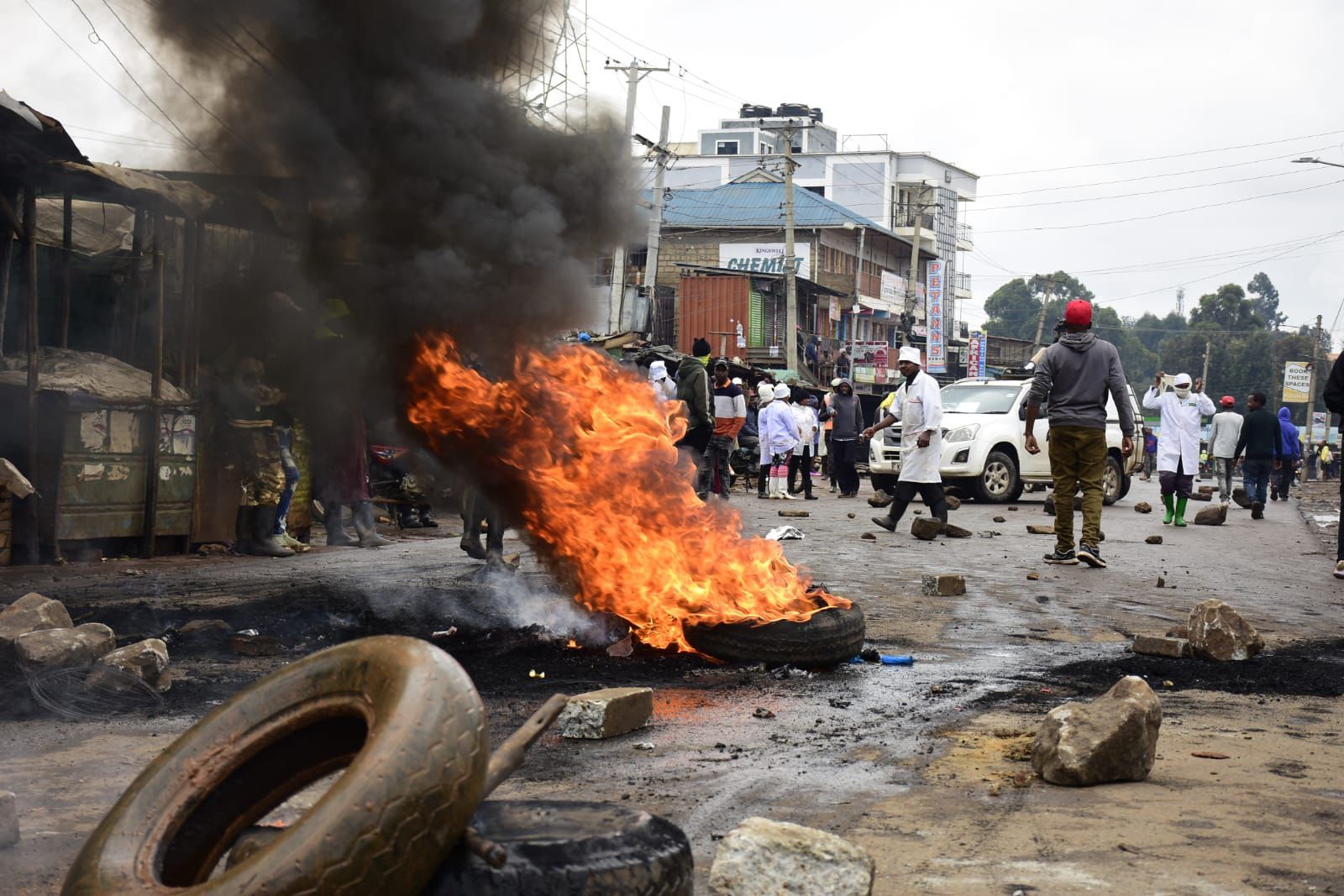
A daylong strike by the transport sector over rising fuel prices turned deadly on Monday after protests in several parts of the country were marred by goonism, violence, looting and violent confrontations with police.
By evening, Interior Cabinet Secretary Kipchumba Murkomen said four people had died in relation to the fuel demonstrations, more than 30 others had been injured, and 348 perpetrators had been arrested.
Murkomen has blamed Monday’s demos on political incitement.
“We are witnessing a clear scheme where a section of the political class is making incendiary statements to fund intolerance and ethnic difficulty and organize goons to spread terror,” said CS Murkomen
Murkomen condemned the violence, saying looting, vandalism and attacks on public property could not bring down the price of fuel. He said the government and matatu sector stakeholders were already in consultation in a bid to end the standoff.
“99 per cent of the country is peaceful. Only one per cent went to the streets,” he added.
The nationwide strike, called by transport sector players, paralyzed movement in parts of Nairobi and other major towns, leaving commuters stranded, businesses disrupted and several roads barricaded. The strike followed sharp increases in fuel prices, with Reuters reporting that petrol in Nairobi rose to Sh214.25 per litre while diesel hit Sh242.92.
Deputy President Kithure Kindiki said President William Ruto, through an online meeting, had directed the Treasury, Transport, Energy and Interior Cabinet Secretaries to meet oil marketers and transport sector stakeholders on Monday at 4pm to explore more ways of reducing fuel prices.
“I want to challenge the critics of this government to look Kenyans in the eye and show us which country has not had fuel prices increasing. This is a global challenge. It is not a Kenyan issue. We must all be truthful,” the Deputy President said.
Kindiki, who spoke while addressing Tharaka leaders at his Irunduni residence, said the meeting was part of the government’s effort to respond to public anger over the cost of fuel.
“If the government had not made the interventions, the price of fuel per litre would have shot to up to between 300 and 400 shillings. So far, we have reduced VAT on petroleum products from 16 per cent to 8 per cent. We have also injected more than Sh12 billion into the stabilization fund. We have done a lot, and we will do more to cushion Kenyans from the pain of high fuel costs,” added DP Kindiki
But even as the government moved to open talks, the situation on the ground continued to deteriorate in several areas.
In Timau, Meru county, one person suffered gunshot wounds during the demonstrations. Meru police commander Moses Musyoka said police later repulsed angry protesters who attempted to set Timau police station on fire.
In Nakuru, five men were admitted at the Nakuru Teaching and Referral Hospital with gunshot wounds. According to the hospital’s Medical Superintendent, Dr James Waweru, three of the patients were from Kiratina in Free Area, one from Murogi, and one from Koleni in Nakuru Town West Sub-county. Two of them were scheduled for surgery.
The violence also spilled into Nairobi’s major access roads.
By 5:23PM, Kamiti Road, one of the busiest feeder roads linking to Thika Superhighway, remained closed. Stones used by protesters to barricade the road had not been cleared as the evening rush hour began, worsening movement for motorists and commuters.
In several areas, what had begun as a protest by transport operators appeared to be hijacked by criminal elements who used the shutdown to intimidate road users, loot, vandalize property and enforce the strike through violence.
The strike had been announced by transport sector players who said all transport subsectors, including passenger transport, cargo, logistics, ride-hailing, motorcycle transport, tourism transport, school buses and private motorists, would take part in the shutdown.
Across Nairobi, protesters lit bonfires and burned tyres on major roads, while police used teargas in some areas to disperse crowds.
The transport sector argues that the latest fuel increases have made operations unsustainable and will ultimately raise the cost of transport, food and basic commodities for ordinary Kenyans.
However, Monday’s violence shifted attention from the cost-of-living grievance to public order concerns, with the government warning that criminality would not be tolerated under the cover of protest.
By evening, the strike had succeeded in forcing high-level government engagement, but at a heavy cost: four deaths, dozens of injuries, hundreds of arrests, disrupted businesses and a transport system shaken by fear and violence.
The outcome of the talks between government officials, oil marketers and transport sector stakeholders will now determine whether the standoff eases or whether Kenya faces another round of transport paralysis over fuel prices.
Follow our social media pages for breaking news updates, in-depth stories and videos.
news@nairobilens.ke