
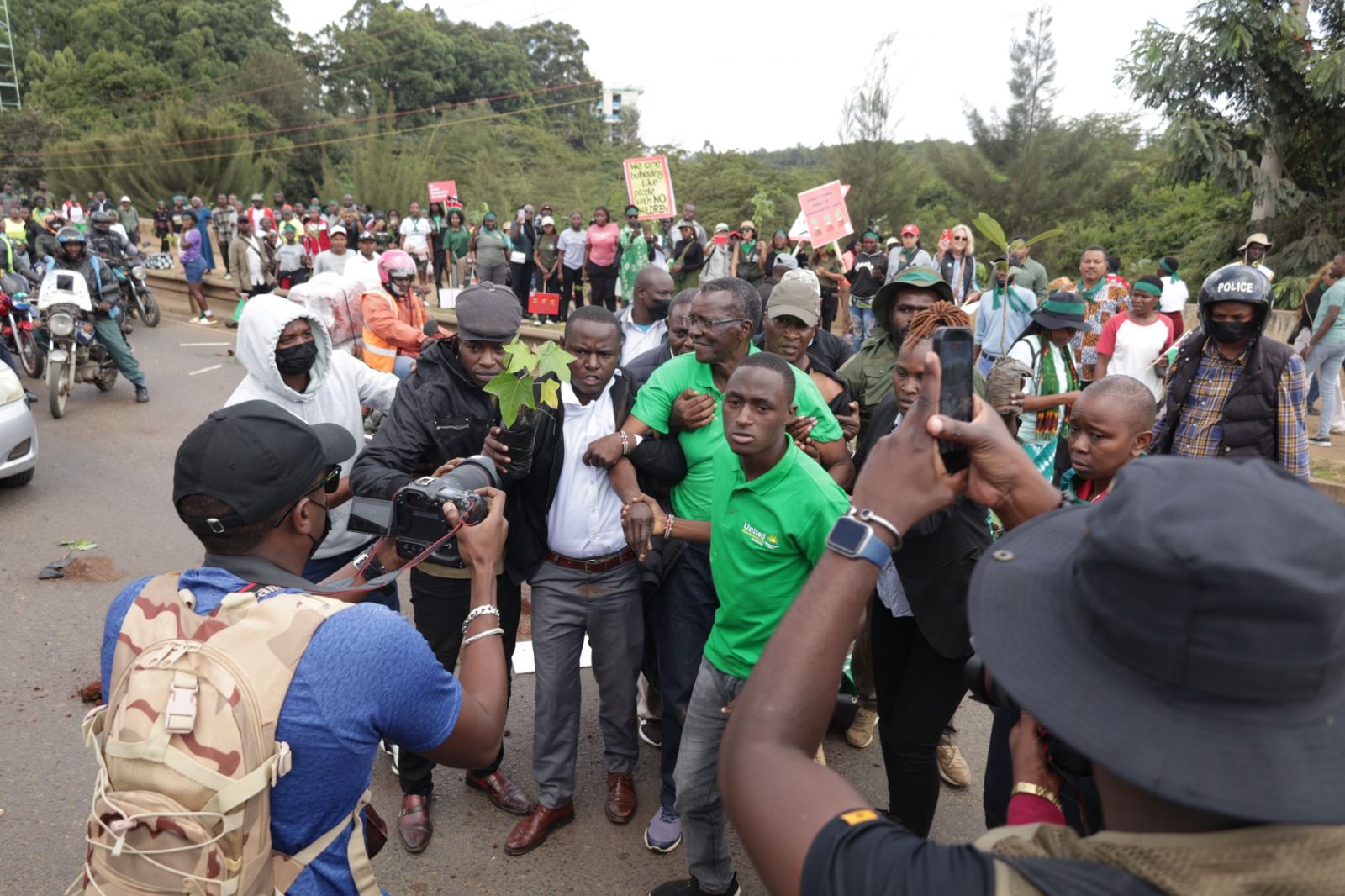
Former Chief Justice David Maraga was on Monday arrested alongside several protesters during demonstrations against reported plans to excise part of Nairobi National Park land.
Maraga, who is also the United Green Movement presidential aspirant, was among protesters who had gathered to oppose the planned excision of land from the protected conservation area. The demonstrators were later taken to Lang’ata police station, where they were being held.
The protest was sparked by concerns over reported plans to hive off approximately 76 acres from Nairobi National Park. Conservationists and civil society groups have warned that the move could threaten the integrity of the park, undermine wildlife conservation and set a dangerous precedent for future development on protected public land.
The protesters argued that Nairobi National Park, which is one of Kenya’s most iconic conservation areas, must be protected from further encroachment. They said the park is already under pressure from rapid urban growth, infrastructure development and shrinking wildlife corridors.
Maraga’s arrest is likely to heighten public attention on the dispute, given his growing political profile and his association with the United Green Movement, a party that has positioned itself around governance, environmental protection and social justice issues.
The former Chief Justice has in recent months become increasingly visible in public-interest causes, including governance and rights-based campaigns. His presence at the protest is expected to frame the Nairobi National Park land issue not only as an environmental matter, but also as a broader governance question around public land, transparency and state accountability.
Environmental groups have maintained that any proposal affecting the park should be subjected to full public participation, environmental scrutiny and legal review. They argue that Nairobi National Park is not ordinary land, but a protected ecological asset with national and international value.
The park, located just outside Nairobi’s central business district, is home to lions, rhinos, giraffes, buffaloes and other wildlife. Its proximity to the city has made it one of Kenya’s most unique tourist attractions, but also one of the most vulnerable to competing development interests.
The latest controversy adds to a long-running debate over how Kenya should balance infrastructure and urban expansion with conservation obligations. Previous projects affecting the park have drawn opposition from conservationists, who say continued fragmentation of wildlife spaces could weaken ecosystems and intensify human-wildlife conflict.
By Monday afternoon, police had not issued a detailed public statement on the arrests. It was also not immediately clear whether Maraga and the other protesters would be released, charged or presented in court.
The arrests are expected to trigger strong reactions from environmental campaigners, opposition figures and civil society groups, particularly if the government does not provide a clear explanation of the proposed land excision and the legal process behind it.
The protesters are opposing reported plans to excise about 76 acres from Nairobi National Park, with reports linking the land to a proposed parking facility associated with Bomas of Kenya. Conservationists argue that any reduction of the park’s protected land could weaken wildlife conservation, open the door to further encroachment, and increase pressure on one of the world’s only national parks located within a capital city.
Nairobi National Park has long faced pressure from infrastructure, urban development and land-use conflicts. Conservationists have previously raised concern that the park is already constrained by the city on several sides, making any further loss of land politically and environmentally sensitive.
Follow our social media pages for breaking news updates, in-depth stories and videos.
news@nairobilens.ke