
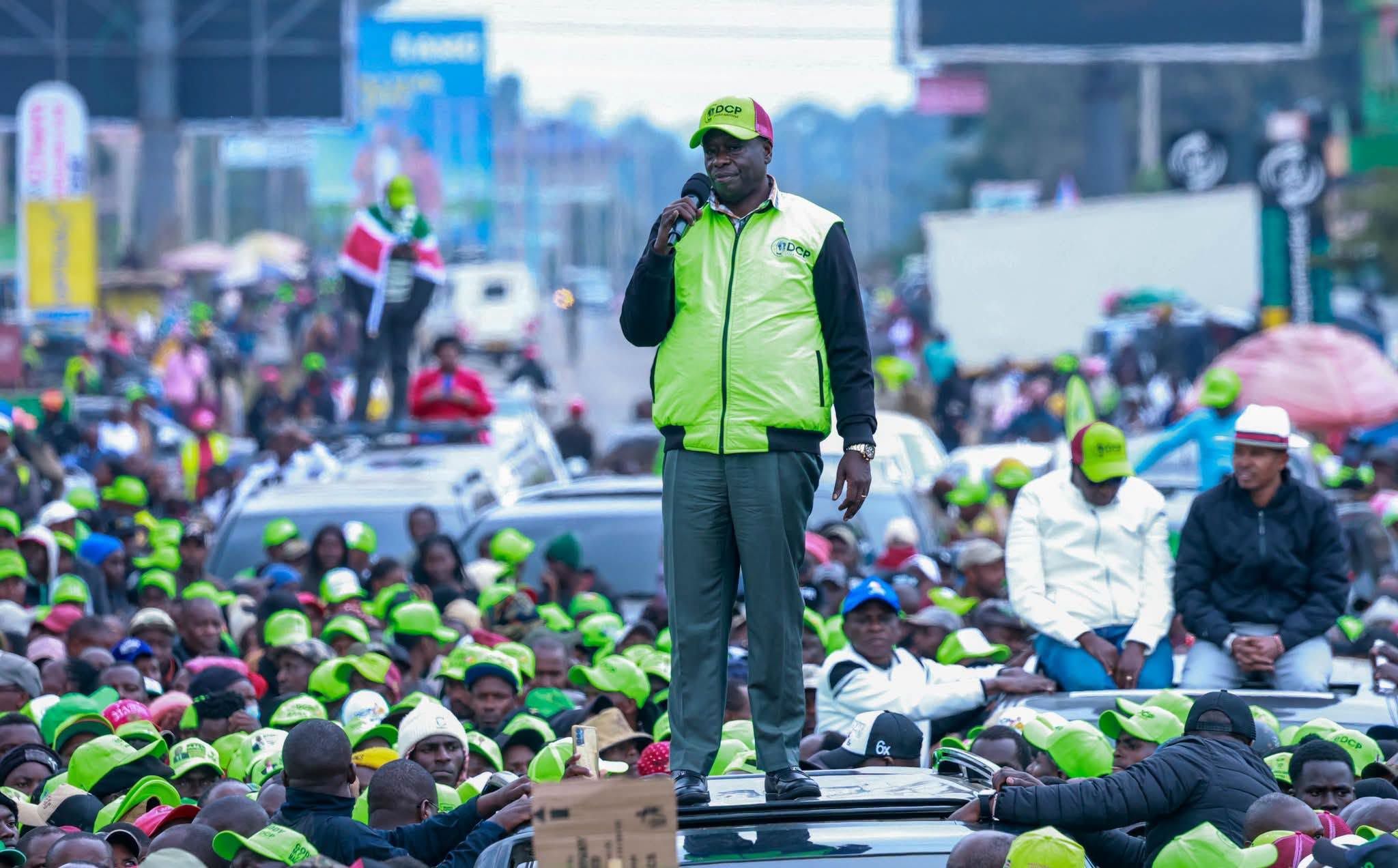
Democracy for the Citizens Party (DCP) leader Rigathi Gachagua has formally positioned himself for the 2027 presidential race, saying consultations held over 55 days at his Wamunyoro residence in Nyeri County showed Kenyans want him to become the United Alternative Government’s candidate.
The former Deputy President, however, said he would be willing to shelve his presidential ambition if his opposition colleagues persuaded him that another candidate stood a better chance of defeating President William Ruto.
Speaking on Monday after concluding what he termed a nationwide listening exercise, Gachagua said opposition unity and the selection of one presidential candidate would be critical ahead of the August 10, 2027 General Election.
“Kenyans have instructed me to persuade my colleagues that I am the best bet to guarantee a first-round win,” Gachagua said.
He cited what he described as his political experience, national networks, organizational infrastructure and public support as factors that would strengthen his case for the opposition ticket.
But he added: “In the event that my colleagues persuade me otherwise, I should not and I will not be the reason why the United Alternative Government should fail to have one presidential candidate.”
The declaration was one of three objectives Gachagua said emerged from consultations with political leaders, professionals, clergy, youth, women, civil society groups, traders, public servants and grassroots representatives.
The first, he said, was to hold the government accountable and oppose what he described as misuse of public resources and violations of citizens’ rights.
The second was to ensure opposition parties rally behind a single presidential candidate in 2027.
His third objective was to seek the United Alternative Government presidential ticket himself.
“We must do what it takes, including sacrificing our own personal political ambition, to identify that one candidate,” Gachagua said.
The former Deputy President said he had initially planned to spend 45 days at his Nyeri home but extended the consultations to 55 days to accommodate more delegations and virtual engagements.
He said the exercise had provided him with views on education, healthcare, agriculture, taxation, security, devolution, unemployment, foreign affairs, public service, the environment and the cost of living.
Gachagua used the address to launch a sustained attack on the Kenya Kwanza administration, accusing it of failing to deliver on promises made before the 2022 election.
He acknowledged his own role in helping President Ruto win that election, saying he now had a responsibility to challenge an administration he believes has failed Kenyans.
“I played a big role to bring this government into power. It is hurting Kenyans. I am playing a bigger role to send it home come 10th August 2027 on the ballot,” he said.
Gachagua dismissed claims that his criticism of the government was driven by bitterness following his fallout with President Ruto and subsequent removal from office.
He argued that he had raised concerns about the direction of the administration while still serving as Deputy President.
A substantial part of his address focused on security and human rights, with Gachagua making serious allegations against state agencies over political violence, abductions and extrajudicial killings.
He claimed Kenyans he consulted wanted investigations and prosecutions extending beyond those who directly committed abuses to officials who may have authorized or coordinated them.
The former Deputy President did not provide evidence in his address to support some of the accusations against government officials and security agencies.
He also called for a public inquest into deaths linked to the 2024 Gen Z-led anti-government demonstrations and subsequent protests, saying families and the public deserved a full account of what happened.
“The people of Kenya are crying for justice,” he said.
On the economy, Gachagua said households and businesses were struggling under heavy taxation, declining disposable incomes and unpaid government bills.
He said traders wanted a predictable tax regime while workers were demanding relief from deductions that had reduced take-home pay.
His consultations, he said, had also highlighted concern over the education system, with demands for stronger free primary and secondary education, free Technical and Vocational Education and Training and a sustainable university funding model.
On healthcare, Gachagua criticised what he described as excessive focus on Social Health Authority registration while hospitals continued to face challenges including medicine shortages and staffing constraints.
He argued that any future administration would need to focus on service delivery, health workers, essential medicines, financing, technology and governance.
Agriculture was another major issue in his address.
Gachagua said farmers had raised concerns over input and food costs and challenges affecting tea, coffee, sugarcane, cotton, pyrethrum and other agricultural value chains.
He also opposed any move that could threaten savings held by cooperative societies, saying members should retain control of assets built through their contributions.
Gachagua further criticised proposed changes affecting consolidated cargo imports, arguing that higher charges would ultimately be passed to consumers.
He also raised concerns over the Kenya Information and Communications (Amendment) Bill, 2025, saying those consulted wanted stronger safeguards for privacy, data protection, transparency and public participation before its passage.
On employment, he said young Kenyans had complained of a lack of decent jobs, low pay, workplace exploitation and heavy taxation.
He pledged to place employment and the creative, sports and digital economies at the centre of the policy programme he intends to develop ahead of the election.
The former Deputy President also touched on regional concerns raised during the consultations.
He cited land disputes and unmet development promises in parts of the South Rift and Maa regions; infrastructure, education and demolitions in Nairobi; port, land and drug-related concerns at the Coast; and poverty, drought and questions over the impact of devolution in Northern Kenya.
In Western Kenya and Nyanza, he said discussions centred on the sugar industry, while North Rift delegations raised concerns about banditry and cattle rustling.
For Mount Kenya, where Gachagua continues to consolidate his political base, he promised to pursue unity.
“For the people of the Mount Kenya Region, I have heard your voice on unity. This will be done. We are one people under one nation,” he said.
Gachagua also promised to prepare a comprehensive policy paper covering the sectors discussed during the consultations.
He said the document would form the basis of a political blueprint that would be presented to Kenyans for further validation after his planned visit to the United States.
He referred to Sessional Paper No. 10 of 1965 and Kenya Vision 2030 as policy frameworks that could inform a longer-term national development agenda.
Monday’s address effectively marked Gachagua’s transition from an extended consultation phase into active 2027 presidential positioning, while leaving room for negotiations within the opposition coalition.
With less than a year to the General Election, the question will now shift to whether Gachagua can persuade his United Alternative Government partners to back his candidature – or whether the broader opposition can agree on another candidate without fracturing the coalition.
Follow our social media pages for breaking news updates, in-depth stories and videos.
news@nairobilens.ke