
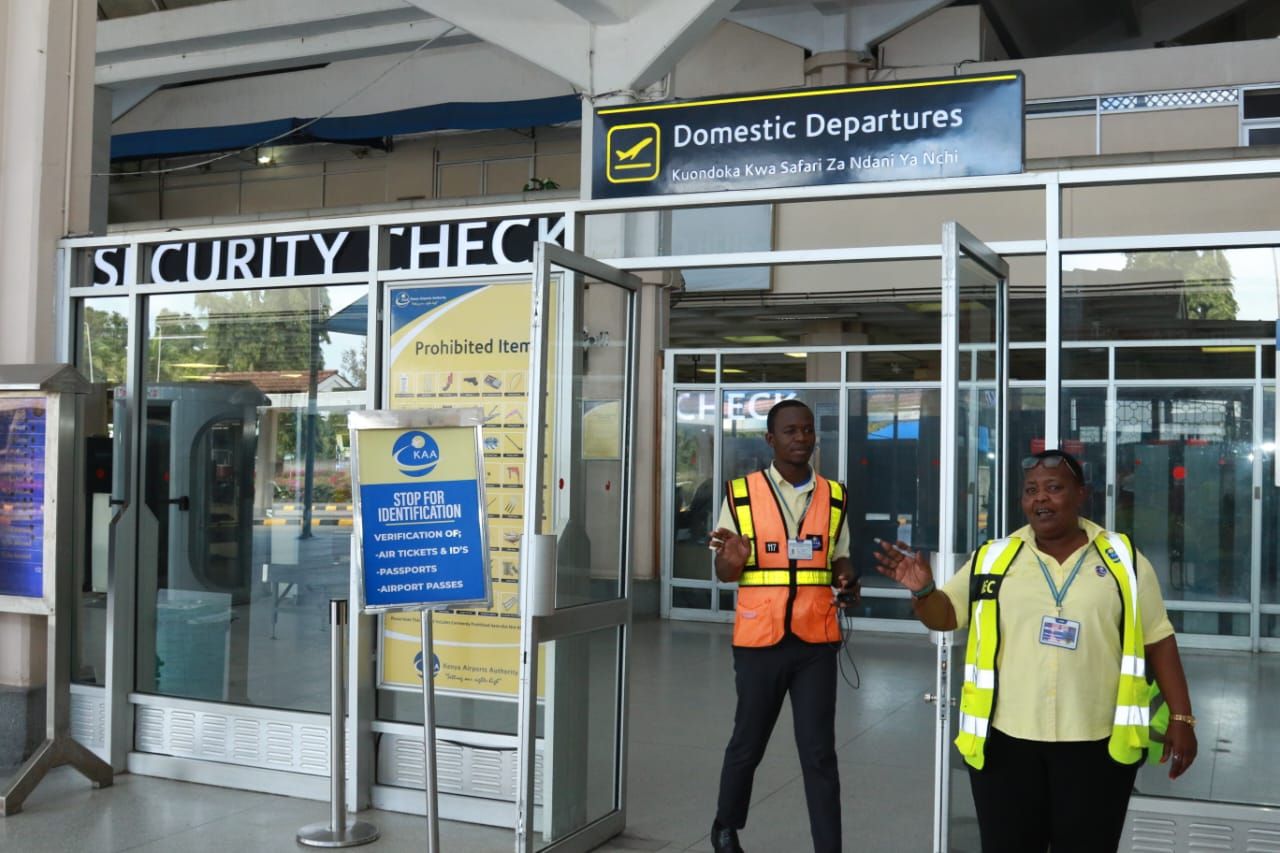
Disruptions caused by an air traffic controllers’ go-slow at Jomo Kenyatta International Airport (JKIA) could have consequences far beyond delayed passengers, with hotel industry player Mohammed Hersi warning that Kenya Airways stands to suffer the biggest operational and financial blow.
In a detailed assessment of the impact of the industrial action in Kenya’s aviation sector, Hersi argues that restrictions on aircraft movements at JKIA can quickly disrupt airline schedules locally and internationally.
“When Nairobi hub coughs, Kenya Airways catches pneumonia,” Hersi said, arguing that the national carrier is more exposed because Nairobi sits at the centre of its network.
Unlike a complete strike where workers abandon their stations, a go-slow can involve air traffic controllers working strictly within procedures while reducing the operational flexibility normally used to keep aircraft moving efficiently.
According to Hersi, the result can be wider spacing between arriving aircraft, slower clearances and fewer flights being handled within a given period.
For international airlines flying into Nairobi, uncertainty over landing slots may force difficult decisions even before an aircraft leaves its point of origin.
“The moment global flight-tracking systems show that JKIA's acceptance rate for incoming aircraft has slowed down, alarm bells go off at airline headquarters on the other side of the world,” Hersi said.
He identified fuel requirements, crew duty limits and aircraft utilization as some of the biggest concerns.
Aircraft approaching a congested airport may be required to remain in holding patterns before landing. Prolonged delays can increase fuel consumption and, if necessary, force aircraft to divert to alternative airports.
Crew working hours are another factor. Pilots and cabin crew operate under regulated duty limits, meaning lengthy delays can leave a crew unable to legally continue a flight once those limits are reached.
The disruption can also affect subsequent flights because commercial aircraft are normally scheduled to operate several sectors within tightly managed timetables.
“A grounded aircraft earns nothing,” Hersi said, noting that a delayed long-haul aircraft can miss its next scheduled rotation and trigger further disruptions across an airline’s network.
He argues that Kenya Airways faces an even greater challenge because its operations are heavily centred on JKIA.
While a foreign airline may cancel or reschedule a single Nairobi service without destabilizing its wider network, disruption in Nairobi can affect several Kenya Airways regional and international connections simultaneously.
“KQ's whole network runs through JKIA,” Hersi said. “When JKIA slows down, it is not one route that suffers, it is the entire airline's schedule that unravels at once.”
Hersi also argues that Kenya Airways has less flexibility than major international airlines with significantly larger fleets.
Aircraft stranded abroad while awaiting clearance to return to Nairobi can incur parking, handling, crew accommodation and other operational costs, while also becoming unavailable for other scheduled flights.
The impact may extend beyond airline balance sheets.
Repeated disruption at JKIA could affect Nairobi’s reputation as a reliable regional aviation hub, particularly as it competes with Addis Ababa, Kigali and other cities for passenger connections and cargo traffic.
Hersi said labour disputes involving aviation agencies should therefore not be viewed solely as an internal employment matter.
“If we are serious about protecting Kenya Airways' recovery and about positioning Nairobi as Africa's premier aviation hub, then resolving labour disputes at KCAA and KAA before they escalate into go-slows cannot be treated as an afterthought,” he said.
“It must be treated as a matter of direct national economic interest.”
Follow our social media pages for breaking news updates, in-depth stories and videos.
news@nairobilens.ke